Introduction
In 2025, medical practices are facing lower reimbursements, higher operational costs, and rapidly changing billing regulations.
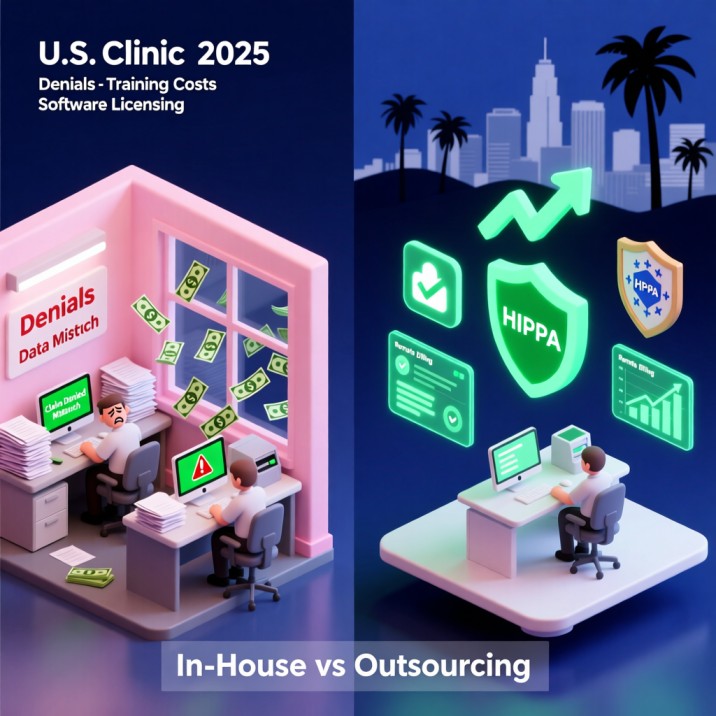
One of the biggest decisions healthcare providers need to make is whether to keep billing in-house or outsource it to a professional medical billing company.
While many practices believe in-house billing is cheaper, the reality is often the opposite. In this article, we break down the true cost comparison—including hidden expenses, staffing challenges, revenue loss, and the financial benefits of outsourcing.
What Is In-House Medical Billing?
In-house billing means your practice hires and manages its own staff to handle:
- Patient registration
- Coding
- Claim submission
- AR follow-up
- Payment posting
- Denial management
- Compliance
- Reporting
This model gives you control—but also creates ongoing cost and management responsibility.
What Is Outsourced Medical Billing?
Outsourced billing means you partner with a medical billing company like Mastermind Healthcare to handle the entire revenue cycle.
The billing company provides:
- Certified coders & billers
- Dedicated AR team
- Real-time reporting
- Denial management
- Compliance oversight
- Software support
- Faster reimbursements
This option reduces workload, cuts operational cost, and increases revenue.
In-House vs Outsourcing – Full Cost Comparison (2025)
Below is what practices actually pay in 2025.
1. Staffing Costs
In-House Billing Costs:
- Medical biller salary: $42,000–$65,000/year
- Coder salary: $50,000–$75,000/year
- AR specialist: $38,000–$55,000/year
- Training & onboarding: $3,000–$6,000/year
- Staff turnover & rehiring: $5,000–$15,000/year
Total staffing cost = $140,000–$200,000 per year, even for a small practice.
Outsourcing Billing Costs: Typically 4–8% of monthly collections. No additional staffing or training cost.
2. Software & Technology Costs
In-House Billing:
- Billing software: $400–$1,000/month
- EHR fees: $300–$700/month
- Clearinghouse: $50–$150/month
- Updates & cybersecurity: $2,000–$5,000/year
Annual cost: $8,000–$15,000
Outsourcing Billing: Included in the billing fee. No software maintenance or clearinghouse fees.
3. Claim Denial Rates & Revenue Loss
In-House Billing:
- Average denial rate: 10%–15%
- Common issues: staff shortages, incomplete documentation, slow AR follow-up
Lost revenue can reach $50,000–$200,000/year.
Outsourcing Billing:
- Denial rates drop to 3%–5%
- Dedicated denial management team
- Faster appeals & stronger coding accuracy
This alone can increase revenue 20–30% annually.
4. Speed of Payments (Collections)
| Model | Average Days in AR | Collection Efficiency |
|---|---|---|
| In-House | 45–60 days | Slower, inconsistent |
| Outsourcing | 25–35 days | Faster, higher cash flow |
Outsourcing improves cash flow—critical for small practices.
Hidden Costs Most Practices Forget
In-House Hidden Costs:
- Staff sick leave / vacation coverage
- Turnover delays
- IT support
- Compliance training
- Audits & penalties
- Errors & write-offs
- Productivity drop during EHR updates
These can easily add $30,000–$70,000/year.
Outsourcing Hidden Benefits:
- Zero downtime
- Always up-to-date coders
- Specialty experts (e.g., OB/GYN, Cardiology)
- Free audits
- Better reporting
- No HR headaches
Side-by-Side Total Cost Comparison (2025)
| Cost Type | In-House Billing | Outsourced Billing |
|---|---|---|
| Staffing | $140k–$200k/year | Included |
| Software | $8k–$15k/year | Included |
| Denials | $50k–$200k loss | Controlled |
| AR Follow-up | Slow | Fast |
| Compliance | Expensive | Included |
| Total Annual Cost | $200k–$350k+ | 4–8% of collections |
Winner: Outsourcing — lower cost + higher revenue
Which Option Is Better for Your Practice in 2025?
Choose In-House Billing if:
- You have a large practice
- You can manage coding, billing, and compliance
- You want full control
Choose Outsourcing Billing if:
- You want to reduce operational cost
- Your denial rate is high
- Cash flow is slow
- You want to focus on patient care
- You want specialists managing your RCM
For 85% of small to mid-size practices, outsourcing is the more profitable option.
Final Verdict — Outsourcing Saves Money and Improves Revenue in 2025
When you compare the true cost — salaries, software, denials, cash flow delays, compliance risks — outsourcing medical billing clearly provides higher ROI in 2025.
Practices that outsource typically see:
- 20–30% revenue increase
- 50–70% fewer denials
- Higher collection rates
- Lower operational cost
- Better compliance & reporting
Looking to Reduce Costs and Increase Revenue?
Mastermind Healthcare offers:
- ✔ Certified coders & billers
- ✔ AR & denial experts
- ✔ Real-time reporting
- ✔ HIPAA-compliant processes
- ✔ Specialty-specific billing
We’ll show you exactly how much revenue you can recover in 2025.
Or call: +1 (812) 329-2773